Princes, Palaces, and Passion:
The Art of India’s Mewar Kingdom
February 2–April 29, 2007
First Exhibition Outside India to
Explore the Art of Fabled Rajasthani Kingdom
Reviewed by Michael Chacko Daniels
Editor & Publisher, New River Free Press International
Rajasthan – literally Land of Kings – is celebrated in the Indian subcontinent for its heroic traditions. In its successful defense from the 14th to late 16th centuries against Muslim invaders, the Hindu kingdom of Mewar came to symbolize the heroic tradition of theLand of Kings.
In the Princes, Palaces, and Passions exhibition at San Francisco's Asian Art Museum, fabled Rajasthan is brought to life in the vibrant colors of Mewar, that sun-burnished area in what is now northwestern India, where the singular ways and fantasies of the rough riders of West and Central Asia met the profuse imaginings of monsoon country.
I highly recommend this exhibition which was eight years in the making.
If the $12 entry fee is too high for you, you can go free of cost, as I did, on Target Tuesday. Plan to go on the first Tuesday in March or April, when it's absolutely free from 10 AM to 5 PM.Court beauty
A court beauty, approx. 1815.
Attributed to Chokha.
India; Rajasthan state, former kingdom of Devgarth,
or Udaipur, former kingdom of Mewar.
Opaque watercolor with gold and silver on cotton cloth.
On loan from Howard Hodgkin,
courtesy of the Ashmolean Museum, Oxford.“The female figure in this painting probably belongs
to a type of beauty whose attributes suggest that she
is desirable and accessible. The twisting pose is skill-
fully composed, tapered torso meeting swaying hips
at a right angle. The woman’s costume emphasizes
her voluptuousness. Her transparent blouse cannot
contain her breasts, and the heavy gold borders of
her skirt and undergarment flare out as though she is
moving. The conventional representation of a
beautiful woman’s eye extending nearly to her ear was
widespread in Indian art.”
~ From the exhibit, wall note, No. 25, Asian Art Museum ~

The court beauty, who is described above in such wonderful detail, merely reflects — in this land of kings and sons of kings — the preferences of the princes both at play and in competition with others.
In the places in the mind where desire rises to take over all else, these illustrations — the comic books, films, and videos of their day — of the life and times of the princes of Mewar must have inflamed the passions of brigand potentates who periodically roared out of West and Central Asia hungry for
booty, beauty, and glory.
The depiction of the "desirable and accessible" court beauties brings to mind Rajasthan's and India's unfinished revolution, all those ways of the past, including nostalgia for its glory days, that mask what has been described as the "anti-female power complex," extending from female infanticide and slavery to differential care, and various stages of purdah.
Try as I did, beholding the court beauties, I could find no romance in them.
However, as a whole, I was fascinated by the artworks
The depiction of the "desirable and accessible" court beauties brings to mind Rajasthan's and India's unfinished revolution, all those ways of the past, including nostalgia for its glory days, that mask what has been described as the "anti-female power complex," extending from female infanticide and slavery to differential care, and various stages of purdah.
Try as I did, beholding the court beauties, I could find no romance in them.
However, as a whole, I was fascinated by the artworks
(74 in all) from the early
sixteenth century to the early twentieth century in
Princes, Palaces, and Passion:
The Art of India’s Mewar Kingdom
— borrowed from museum and private collections in Great Britain, Australia, and the United States to reflect "the depth and range of Mewar’s artistic achievement."
Why? Because the exhibition goes beyond the works produced for the courts and explores the intersection of histories, beliefs, narratives, and customs of court, temple, and village. This break from the tradition in how the art from the Rajasthani kingdoms is exhibited gives the viewer a more rounded experience of the life and times of the centuries represented.
sixteenth century to the early twentieth century in
Princes, Palaces, and Passion:
The Art of India’s Mewar Kingdom
— borrowed from museum and private collections in Great Britain, Australia, and the United States to reflect "the depth and range of Mewar’s artistic achievement."
Why? Because the exhibition goes beyond the works produced for the courts and explores the intersection of histories, beliefs, narratives, and customs of court, temple, and village. This break from the tradition in how the art from the Rajasthani kingdoms is exhibited gives the viewer a more rounded experience of the life and times of the centuries represented.
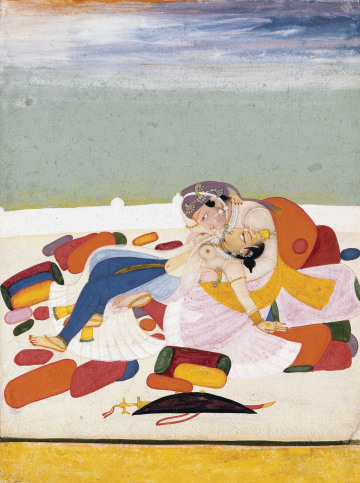
Passivity & Love
Lovers
Lovers on a terrace, approx. 1810.
Circle of Chokha. Rajasthan state, probably Udaipur,
former kingdom of Mewar. Opaque colors on paper.
Promised gift to Walters Art Museum, Baltimore,
Mr. and Mrs. John Gilmore Ford Collection.“The man in this couple is an unidentified prince. The
couple’s amorous embrace suggests passive delight on
the woman’s part. His eyes focus on her firm breasts
and hers on the colors of the clouds. The bolsters are
in vivid disarray from the lovers’ activities.
This image seems to belong to a group of versions
of a similar subject produced by painters of this period
for training or in competition. This picture is perhaps
the most vivid in this series, with the luminous colors
of the bolsters framing the delicately painted torsos
of the pair, and jewelry reflecting the color of the sky.
The painter was skilled in several kinds of brushwork:
delicately refined on the faces, flat on the intense tex-
tiles, and pale in the washes for sky and white cotton
clothing. . ."
~ From Press Release, Asian Art Museum ~
Surajmalji
Surajmalji
Son of Rao Narayanadasa, approx. 1820.
Rajasthan state, probably Udaipur,
former kingdom of Mewar.
Ink, opaque watercolor, and gold on paper.
University of California, Berkeley Art Museum,
gift of Jean and Francis Marshall, 1999.15.11.1.
Photographed for the Berkeley Art Museum
by Benjamin Blackwell
"'Surajmalji, son of Rao Narayanadasa,' the phrase
inscribed on the reverse of this small painting, sug-
gests a historical if less commonly represented subject.
Surajmal is a common name in several royal lineages;
however, the individual depicted here has not been
precisely identified. This noble archer—dressed in
green for hunting, possibly on the run from his ene-
mies in the jungle—must be a heroic ancestor of some
Mewar royal family.
The pictorial style is that of Mewar in the early
1800s, combining fine calligraphic brushwork in the
vegetation and broad, wet brushstrokes defining
larger forms. The result serves to stress
the central figure."
~ From the exhibit, wall note, No. 31, Asian Art Museum ~

Assumption of Anonymity Challenged
The dozen plus paintings by Mewar painters Bakhta (active 1760–1810) and his son Chokha (active 1799–1824) that have been collected in this exhibition challenge the common assumption that all Indian art was the work of anonymous painters.
Going Beyond The Courts
To Include Temple And Village Art
One of the intriguing features of the exhibition is that it goes beyond the works produced for the courts and explores the intersection of histories, beliefs, narratives, and customs of court, temple, and village. This break from the tradition in how the art from the Rajasthani kingdoms is exhibited gives the viewer a more rounded experience of the life and times of the centuries represented.
“The work of village artisans is a vibrant feature of Mewar’s artistic landscape. The potters’ village of Molela still makes images for tribal people, who walk hundreds of miles across hills and desert to take these terracottas (examples featured in the exhibition) back to their modest yet colorful mud shrines. Furthermore, three towns in this region have long produced large paintings of folk epics known as phads. A bhopa, a storyteller/priest, would purchase a painting from a Brahman painter and travel on camel back all over Rajasthan to perform at important events for the herder communities. The exhibition includes a phads, which is at once a complex picture, a backdrop, and a shrine to the deified hero. The exhibition- related programs include presentations at the Asian Art Museum by a bhopa from India. The daily presentations are tentatively scheduled for 2:30 pm, April 5 through 15 (please confirm at www.asianart.org)."
“Princes, Palaces, and Passion goes beyond an exploration of the courtly arts of Rajasthan to highlight some of the many ways in which court, temple, and village were inextricably linked. The artworks on view explores the rich interactions that occurred between specific courts and many different aesthetic arenas. There are interesting caste and family connections among different painting traditions in the Mewar region. In Nathadwara, traditional painters producing the picchwais have the same caste background as the aforementioned imperial painters, and their present day milieu may shed light on the origins of other great painters. Likewise the long narrative cloth phads were created by painters with caste connections to the other groups. The itinerant nature of these images is a fascinatingexample of the dispersal of style.”
~Excerpts from the Museum’s Press Release~
]]>More Exhibition & Museum Details
Princes, Palaces, and Passion
was organized by the Asian Art Museum, and
curated by Dr. Joanna Williams, professor of art history at
University of California, Berkeley.
Exhibition Publication
Kingdom of the Sun:
Indian Court and Village Art
from the Princely State of Mewar
This major catalogue, edited by exhibition curator Joanna Williams of the University of California, Berkeley, and produced by the Asian Art Museum to accompany the exhibition Princes, Palaces, and Passion, includes five original essays by leading scholars as well as detailed entries on each of the objects in the exhibition. Containing 170 full color illustrations as well as a glossary, a bibliography, and an index, this book provides an authoritative overview of the varied arts of Mewar. 81⁄2 x 12 in., 240 pp., paperback, 170 illus., glossary, bibliography, index, est. price $40 (inquire at shop@asianart.org).
Acknowledgments
Princes, Palaces and Passion: The Art of India’s Mewar Kingdom is made possible by generous support from Macy’s, the Bernard M. Osher Foundation, E. Rhodes and Leona B. Carpenter Foundation, R. Gwin Follis Foundation, the National Endowment for the Arts, Rajnikant and Helen Desai, and an anonymous donor. Additional support has been provided by The Brayton Wilbur Foundation in memory of Brayton Wilbur, Jr. Media sponsors: The Mercury News and mercurynews.com.
About the Asian Art Museum
The Asian Art Museum is a public institution whose mission is to lead a diverse global audience in discovering the unique material, aesthetic, and intellectual achievements of Asian art and culture. Holding nearly 16,000 Asian art treasures spanning 6,000 years of history, the museum is one of the largest museums in the Western world devoted exclusively to Asian art. Once located in Golden Gate Park, the museum now resides at its new, expanded facility at Civic Center Plaza. An architectural gem featuring a dynamic blend of beaux arts and modern design elements, the museum’s new home is the result of a dramatic transformation of San Francisco’s former main library building by renowned architect Gae Aulenti (designer of Paris’s Musée d’Orsay) into a showcase for the museum’s acclaimed collection and exhibitions.
Information
(415) 5813500, or www.asianart.org.
Location
200 Larkin Street
San Franciso, CA 94102
Hours
The museum is open
Tuesday through Sunday from 10:00 AM to 5:00 PM,
with extended hours until 9:00 PM every Thursday.
Thursday evenings after 5 PM
Admission
$12 for adults, $8 for seniors,$7 for youths 12-17, and free for children under 12.On Thursday evenings after 5 PMadmission is just $5 for all visitors except thoseunder 12 and members, who are always free.
FREE on Target Tuesdays
The museum offers FREE admission to all on
the first Tuesday of every month from 10 AM to 5 PM,
courtesy of Target Stores
Wheelchair Access
The Asian Art Museum is wheelchair accessible.
For more information regarding access,
please call (415) 5813598; TDD: (415) 8612035.